
Boundaries are not a weakness. They are the work.
The boundary you haven’t set is costing you more than you think
Let’s talk about something most leadership programs never cover.
Not strategy. Not execution. Not vision, culture, or team performance, though all of those things matter deeply.
Let’s talk about boundaries.
Because here is what we have learned working alongside leaders at every level: the absence of boundaries is one of the most common and most costly leadership gaps we see. And it is also the least talked about. We celebrate the leader who is always available. We reward those who take on more. We quietly admire the person who never seems to say no. And in doing so, we have collectively created a standard of leadership that is quietly breaking the people who are trying to live up to it.
Boundaries in leadership are not about being difficult. They are not about being selfish, unavailable, or less committed than the person in the next office. They are about something far more important than any of that.
They are about being sustainable. Being honest. Being present. And leading from a place of genuine strength rather than quiet depletion.
Think about the last time you said yes when everything in you wanted to say no. The last time you took a call you should not have taken. The last time you absorbed someone else’s urgency and let it become your own. The last time you stayed available long past the point where you had anything real left to give.
Now think about the quality of your leadership in those moments.
That is what this edition is about. Not the concept of boundaries as a self-care trend or a buzzword. Boundaries are a leadership necessity. Boundaries are one of the most powerful and most neglected tools in a leader’s toolkit. And most importantly, what it actually looks like to build and hold them at every level of leadership in the real, demanding world we actually lead in.
Let’s sit with this together.
WHY THIS MATTERS AND WHY IT IS HARDER THAN IT SOUNDS
We struggle with boundaries, not because we do not understand them. We struggle because setting them feels like it contradicts everything we were told good leadership looks like. We were told to be accessible. To be team players. To go above and beyond. To put the mission first. And somewhere in absorbing all of that, many of us lost the ability to protect our own time, energy, and focus, the very things that make great leadership possible in the first place.
For new leaders, the challenge is often about proving yourself. You want to show that you are committed, capable, and worthy of the role. So you say yes to everything. You make yourself available at all hours. You take on more than is sustainable because turning something down feels like turning down the opportunity itself. And for a while, it works. Until it does not.
For senior leaders, the challenge is different but equally real. By the time we have been leading for years, the expectations around our availability and output have become embedded in our culture. We have trained our teams, our peers, and our organizations to expect a version of us that never says no, never slows down, and never runs out of capacity. And changing that pattern, even when we know we need to, feels like a betrayal of something.
Neither of these struggles is a character flaw. They are the natural result of a leadership culture that has never properly valued the boundaries that sustain great leadership.
But here is what we know: a leader without boundaries is not a stronger leader. They are a more depleted one. And depleted leaders do not make better decisions. They do not have deeper conversations. They do not create the kind of space their teams need to grow. They just keep going until they cannot.
That is the cost. And it is far higher than the discomfort of saying no.
WHAT BOUNDARIES IN LEADERSHIP ACTUALLY LOOK LIKE
Before we talk about how to build them, let’s get clear on what we mean because boundaries in leadership are not always what we picture.
A boundary is not a wall. It is not a policy. It is not a sign on your door that says do not disturb.
A boundary is a clear, honest, and intentional decision about how you will show up and how you will not. It is the commitment to protect what makes you effective so that you can bring your best to the people and work that need it most.
It looks like this.
It is the leader who closes their laptop at a certain time, not because they do not care about the work, but because they understand that rest is part of the performance.
It is the leader who declines a meeting that does not require their presence, not because they are avoiding responsibility, but because their time is a finite resource that deserves to be used intentionally.
It is the leader who does not respond to every message the moment it arrives, not because they are unavailable, but because reactive availability trains teams to stop thinking for themselves.
It is the leader who has the honest conversation about what they will and will not take on, not because it is difficult, but because clarity is always kinder than the slow resentment of overcommitment.
And it is the leader who models all of this visibly because when leaders set boundaries with confidence and without apology, they give their entire organization permission to do the same.
That last one is worth sitting with. Because one of the most important things a leader can do for their team is model a sustainable way of working. When we never stop, we silently signal that stopping is not okay. And we create teams of burned-out, over-extended people who are afraid to admit they have a limit.
KEY ACTIONS LEADERS CAN TAKE NOW
Get honest about where your boundaries are missing.
Before you can build better boundaries, you have to see where they are absent. Where are you consistently over-extended? Where do you say yes when everything in you means no? Where do you feel resentment starting to build, because resentment is almost always a signal that a boundary has been crossed, often by ourselves?
Try this: At the end of this week, look back at your calendar and your commitments. Circle the three things that cost you the most and gave back the least. Ask yourself what a boundary would have looked like there. Start there.Define what you are protecting and why.
Boundaries without intention are just restrictions. Boundaries grounded in a clear 'why' become a leadership philosophy. What are you protecting? Your thinking time? Your energy for the people who need you most? Your health, your relationships, your capacity to lead well over the long term?
Try this: Write down the three things that, when protected, make you a significantly better leader. Then look at how much of your week is actually structured to protect them. The gap between those two things is where your boundary work begins.Communicate your boundaries with clarity and without apology.
One of the most powerful things a leader can do is name their boundaries out loud. Not defensively. Not with a lengthy explanation. Simply, clearly, and with confidence. I do not take calls after a certain hour. I block out focused time on my calendar and protect it. I am not available on weekends unless something is genuinely urgent.
Try this: Choose one boundary you have been quietly holding but never named. Say it out loud to one person this week, a peer, a direct report, or your own manager. Notice how the act of naming it changes how firmly you hold it.Stop making availability your leadership identity.
If being reachable at all times has become part of how you define your value as a leader, that is worth examining. Constant availability is not a leadership strength. It is a pattern, often rooted in a fear of what people will think if we are not there the moment they reach for us.
Try this: Choose one window of time this week where you are intentionally and visibly unavailable. No messages, no calls, no quick checks. Use that time for your most important work. Notice whether the world ends. It will not.Model it so your team feels permission to do the same.
This is perhaps the most underestimated leadership move of all. When you leave the office without sending emails at midnight, take your time off without apologizing for it, and talk openly about protecting your energy and focus, you create a culture where your people feel safe doing the same. And teams that are rested, boundaried, and not constantly running on empty perform better. Full stop.
Try this: In your next team meeting, share one boundary you are actively working on. Not as a confession, but as a model. Watch how quickly others feel permission to do the same.
A reflection before you move on.
What would change in your leadership if you gave yourself full permission to protect your energy, your time, and your focus not as an act of selfishness, but as an act of service?
Because that is the reframe that matters most. Boundaries are not about what you are withholding from others. They are about ensuring that when you show up, you are actually there. Fully present, genuinely engaged, and leading from a place of strength rather than survival.
That is the kind of leadership that sustains. That is the kind that people remember. And it starts with the decision to protect what makes it possible.
“Daring to set boundaries is about having the courage to love ourselves, even when we risk disappointing others.”

Resources to Dive Deeper
Set Boundaries, Find Peace by Nedra Tawwab: Tawwab’s accessible and deeply practical guide to understanding where our boundaries break down and how to rebuild them, written for real life, not just the therapy room.
The Power of Full Engagement by Jim Loehr and Tony Schwartz: A research-backed argument that managing energy, not time, is the key to sustained high performance. One of the most important leadership reads on why protection of capacity is the foundation of everything else.
Essentialism by Greg McKeown: McKeown’s case for doing less but better is a masterclass in the kind of intentional focus that only becomes possible when leaders are willing to protect it fiercely.
FROM OUR DESK
The best leaders reflect before they react. The Leader Is You: A Daily Growth Journal gives you a space to do exactly that to slow down, ask the hard questions, and show up more intentionally every day. Whether you are working through a shift like the one in this edition or simply trying to lead with more clarity and purpose, this journal travels with you and meets you where you are.
—————————
And if you're ready to go deeper than a journal can take you — the Leadership Mastermind is for you.
This is a small, curated group of leaders committed to growing together. Bi-weekly live sessions. Executive coaching. Real conversations about the challenges you're actually facing — succession, trust, AI, burnout, all of it. No fluff. No audience. Just a room of serious leaders doing serious work.
Doors are currently closed, but the waitlist is open.
If leading with purpose, power, and presence is the standard you're holding yourself to in 2026 — this is where that work gets done.
Spots are limited. The leaders already on the list won't wait for you.

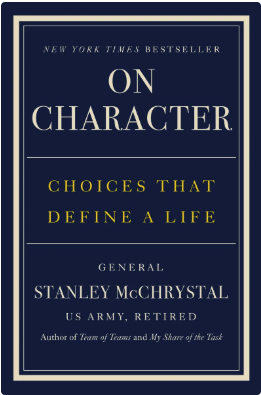
On Character by General Stanley McChrystal
"In the AI age where competence can be automated, character is the last distinct human advantage."
McChrystal's central argument is both simple and demanding: character is not a fixed trait, it's a daily practice. A muscle. A set of choices made under pressure, repeatedly, over time.
In a moment when competence is increasingly automatable, and AI can generate strategy, write analysis, and model decisions, McChrystal asks: what's left that's distinctly human in leadership? His answer is that character is the moral fiber that shapes how leaders behave when no one is watching, when the answer isn't clear, and when the pressure is high.
Drawing on decades of military command and executive consulting, he breaks character down into actionable choices—not aspirational qualities. This isn't a book about being a good person. It's a book about the daily decisions that constitute who you are as a leader.
Best for: Leaders navigating high-stakes change who want to lead from the inside out. Especially timely as AI redefines what "competence" means.

Consider how many different pieces of content you see in any given week. See something that resonates with you? Share it with us to feature it in our Social Media of the Week section.
“You get what you tolerate.”
— Henry Cloud